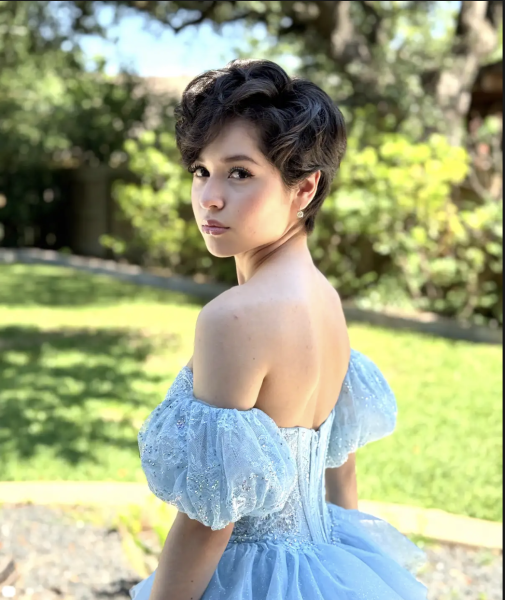

Ready to open their notes packet and take out writing utensils, AP Biology students prepare to learn about the complex concept of heredity and the structure of pedigrees. As the first bell rings, everyone expects to be taught by a science teacher who went to college, got her degree, and is an expert in biology — and that is all true. What they don’t expect, however, is to also be taught by a baker, book lover, and someone who has a family large enough to inhabit a small city. With a heart for science and passion for education, Ms. Morgan Dever was warmly welcomed to the science department as its sole AP Biology teacher.
Impressed by the Warriors’ reputed pursuit of high standards, Ms. Dever always knew Westwood was the best school for her to bestow her extensive knowledge of biology upon, adding more depth than typical, repetitive PowerPoint lectures.
“I grew up here, so I’ve known about Westwood for a long time,” Ms. Dever said. “I went to Rouse High School in Leander, Texas, and we would have competitions against Westwood and anything that had to do with math. For example, we would get second [at competitions] because Westwood already won first. My first ever impression [of Westwood] was really a long time ago, and I always knew that the kids were smart. I want to be around students who want to learn and not just write down fluff.”
Hoping to introduce a personal spin on a traditional lesson, Ms. Dever plans to introduce her uniquely large family of seven generations, the Hoelscher-Buxkemper family from Olfen, Texas, to her AP Biology students when learning about pedigrees and heredity during Unit 5 of the course, sharing her love for her family, the science behind heredity, and her identity.
“We have the biggest family reunions in Texas, and I’m going to try to use that during our pedigree unit to see if [students] can figure out my family,” Ms. Dever said. “[My family] left Germany in 1846 to escape the Prussian War, only to be dragged into the Civil War of America. When they first moved to the States, they started little towns, and [my family] just got bigger and bigger. When my family gets together, we rent out coliseums and people have to wear dots representing what branch they are from the tree. We [also] have this big book [of family history] that everyone gets, and we have our own website.”
After instructing college labs while studying at Texas State University, Ms. Dever fell deeper in love with biology, spurring on her journey in teaching. Presented with the opportunity to study microbiology, an optional yet challenging course, she enthusiastically took it, marking the start of her teaching career.
“It all started when I was in [Texas State University],” Ms. Dever said. “I took microbiology. I actually should have taken the other [lower-level biology class] first, but somehow I was allowed to take micro[biology] first. I loved knowing that there were all these tiny little worlds happening. When I was completing my microbiology for a portion of my degree, I became a teacher for the labs and I really liked it. Then, a scholarship grant came up for grabs in the Physics department, and they were letting in one biology student. [The grant] was to become a teacher, and my college [tuition] would be paid for if I promised to teach. I applied, and I got the scholarship and grant, so my college was free. [After that, I] just kept teaching.”
Inspired by the teaching methods of her passionate college professors and mentors, Ms. Dever wants her own students to feel the same way after learning from a lecture: prepared and excited to learn more.
“I took seven classes with [Dr. Manish Kumar],” Ms. Dever said. “He was my mentor and I taught his labs. He was just so no-nonsense. He was from India, and he would tell us at the beginning of the year, ‘I’m like broccoli, and you guys are like burgers, and it’s delicious but I’m broccoli. I’m not the burger you want, but I’m good for you.’ That was just his mindset.”
Determined to make an impact on the scientific knowledge of her students, Ms. Dever plans to feed her students that same intellectual “broccoli” mindset. Although Ms. Dever acknowledges the shift in mindset will feel academically shocking at first, she is certain that it will be helpful once her students graduate and step into their first college science lecture. Understanding that no high grades come for free, she reveled in the challenge of the work from her science classes, acing all of them.
“Having a science teaching background, I know what’s expected and I want my kids to go into college being like ‘I’ve already got this down — Ms. Dever taught me how to be ready for this,’” Ms. Dever said. “They will be scientifically literate and the leaders in their group. Especially if a kid has really high aspirations for pre-med, I really don’t want kids to go to college and be shocked at the workload that’s expected of them for science classes.”
In her college days, Ms. Dever not only taught and directed labs, but also engaged in extensive scientific research that eventually allowed her research team to test their experiments in space. When working with Dr. Robert McLean, a biofilm researcher, her curiosity grew from the possible effects space could have on bacteria. Whether it’s teaching or research, Ms. Dever is dedicated to having an astronomical impact on the scientific world around her.
“After I did research in the college level, I was working with Dr. [Robert] McLean whose research was biofilm,” Ms. Dever said. “What we were looking at was ‘how does zero gravity — so when when bacteria goes up into space — affect those virulence factors?’ That would be looked at through their DNA sequence. We sent five bacteria up into space with NASA. We needed to figure out how DNA in the bacteria [causes] increase in biofilm formation.”
When Ms. Dever’s not teaching hydrogen bonding or grading papers on protein formation, she retreats to the kitchen, grabs her Martha Stewart cookbook, and transforms from a high school biology teacher into a prolific baker.
“I’ve been baking since I was a kid,” Ms. Dever said. “I love to bake any dessert. I actually bought a Martha Stewart cookbook, and I’m working through Martha Stewart’s recipes for her desserts. I’m huge on scones, bread, cookies, brownies, cakes. I don’t like to decorate at all. For any recipe that does not require decorating, I’m good to go.”
Having gone through the most challenging science classes available, Ms. Dever understands the packed workload clouding the minds of high school students. She has deep faith in her students’ success.
“I really just want to inspire [students] that they can do it and to just push themselves,” Ms. Dever said. “As long as you’re willing to try, you will succeed. Nothing in life is do or fail, and so if you’re willing to put in the effort to get to the big show, the big game, or whatever it is, you will succeed when you get there, and I want to inspire my kids to feel like they can achieve anything.”