
Each year, thousands of women athletes participate in the highest level of sporting events. Simone Biles, Serena Williams, Gabby Thomas, and Katie Ladecky are just a few names who have showcased their outstanding athletic capabilities on the largest stages. However, much of this wouldn’t have been made possible without the efforts of Billie Jean Moffitt, better known as Billie Jean King.
King was born on November 22, 1943 in Long Beach, California, to parents Bill and Betty Motiff. King was welcomed into the world of sports at a very young age, growing up in a sports-loving environment. King’s father had previously tried out for an NBA team before becoming a firefighter, and King’s mother was a decorated swimmer. Additionally, King’s brother, Randy, pitched for multiple Major League Baseball teams.
King played all the sports she could get her hands on. She started off in the footsteps of her father, by playing basketball. However, by age ten, King decided she was ready for softball; King played shortstop and played with an older age group, under 14, alongside winning the city championship. King’s father would later recommend tennis, and King began practicing tennis soon after. This little suggestion would serve as a catalyst for a lifetime of advocacy for women’s sports.
King would spend long hours on local Long Beach public courts practicing from dusk till dawn. Hoping that her skills would one day be showcased at the highest level. However, a challenge struck when King realized that the standards for women were a lot different to those of men. Despite competing at the highest levels, women still were underpaid and underrepresented in nearly all of women’s sports. This realization would pave the way for King’s advocacy for equal rights in the game of tennis.
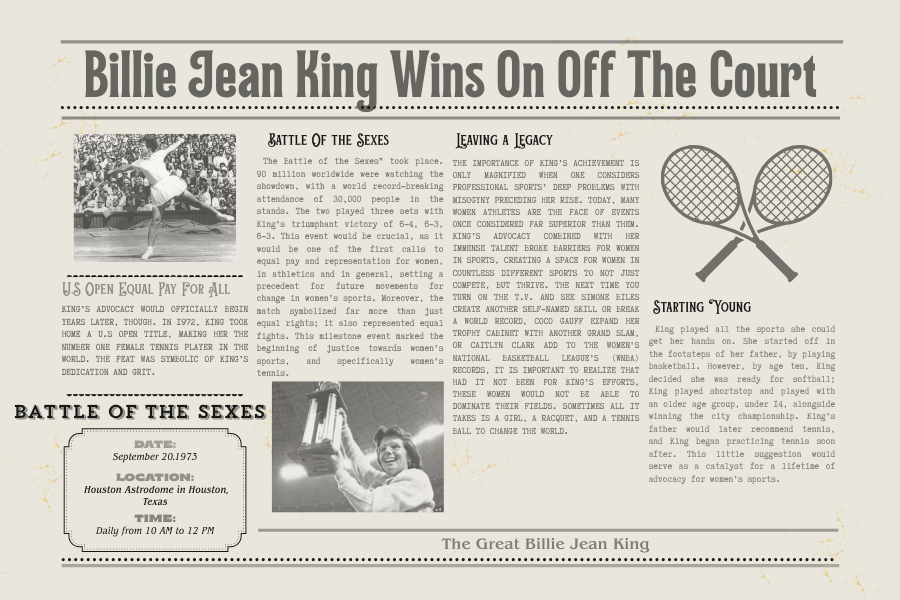
King’s advocacy would officially begin years later, though. In 1972, King took home a U.S Open title, making her the number one female tennis player in the world. The feat was symbolic of King’s dedication and grit. However, King brought home $10,000, while the men’s winner, Ilie Nastase, brought home $25,000. Upon hearing this, King made it very clear in the post-game press conference that if the wage gap at the tournament wasn’t cleared, she and other female athletes would boycott the event.
King’s advocacy did not just stop there. In 1973, King would change women’ s sports forever. After lobbying for equal pay, the U.S Open became the first sporting event in the world to give equal money prizes to men and women. Furthermore, King and 60 other female athletes gathered together to create the Women’s Tennis Association, or WTA, in response to downplaying of female sports and financial discrimination as a result of one’s gender. 1973 was a revolutionary year for King, and her efforts of advocacy were finally starting to be heard. However, her greatest feat was yet to come.
During the 1930s and 40s’, Robert Larimore Riggs had dominated much of the male tennis world. Riggs himself was a U.S Open champion, accompanied by 2 other Grand Slam titles. Furthermore, at one point, Riggs was ranked world number 1 for men’s tennis. Riggs was not an open advocate of women’s tennis, openly stating it was “inferior to the men’s game,” and proceeded to make a variety of dismissive remarks regarding women’s sports.
Hearing Riggs’ bold and harsh criticism, a 29-year-old Billie Jean King wasn’t going to have it, and challenged him to a match. The 55-year-old Riggs had previously beaten another top female tennis player, Margaret Court. His arrogance was boasted all over the world on television. On September 20, 1973, “The Battle of the Sexes” took place. 90 million worldwide were watching the showdown, with a world record-breaking attendance of 30,000 people in the stands. The two played three sets with King’s triumphant victory of 6-4, 6-3, 6-3. This event would be crucial, as it would be one of the first calls to equal pay and representation for women, in athletics and in general, setting a precedent for future movements for change in women’s sports.
Moreover, the match symbolized far more than just equal rights; it also represented equal fights. This milestone event marked the beginning of justice towards women’s sports, and specifically women’s tennis. It was a groundbreaking event, and ‘King’ became a household name. Following the match, King went on to win more grand slam titles, and continued her advocacy for women.
The importance of King’s achievement is only magnified when one considers professional sports’ deep problems with misogyny preceding her rise. Today, many women athletes are the face of events once considered far superior than them. King’s advocacy combined with her immense talent broke barriers for women in sports, creating a space for women in countless different sports to not just compete, but thrive. The next time you turn on the T.V. and see Simone Biles create another self-named skill or break a world record, Coco Gauff expand her trophy cabinet with another Grand Slam, or Caitlyn Clark add to the Women’s National Basketball League’s (WNBA) records, it is important to realize that had it not been for King’s efforts, these women would not be able to dominate their fields. Sometimes all it takes is a girl, a racquet, and a tennis ball to change the world.